1. INTRODUCTION
0il palm replanting is normally carried out after a period of about 25 to 30 years economic life span. Replanting provides an opportunity for the estate to make improvement on the present system such as accessibility for mechanization and re-alignment of road, drain intensity, planting density, and it also can solve the harvesting problem, low yield and prevailing prices of palm product. Replanting is one of the practical strategies to improve oil palm productivity. It provides opportunities for estate to rectify any physical problems or shortcomings that had been encountered in the past and to carry out some improvement for the present system such as planting density, accessibility for mechanization re-alignment of roads, drainage system and etc. The policy of zero burning practice currently adopted in the replanting of oil palm plantation is a good example towards the development of more sustainable practices based on nutrient supply and organic residues management.
2. ESTATE EXPERIENCE AND FIELD VISIT OBSERVATION
At my working place, Negri Sembilan Oil Palms Berhad, Ladang Ibam have 2,150 hectare and overall age of palms was 21 to 22 years already that was planted on the year 1989 & 1990. We had decided to do the replanting last year for two fields for a year and another two blocks for this year and so on. The field that we selected for replanting (the first two field for replant) because of the yield production is already low and problem for harvesting and transportation. We were started replanted two fields at last year about 212 heactare. For this year, we had done for chipping to another two fields and now on, we are doing the terracing, road, boundary before we start to replant the seedling. Our estate also adopted the zero burning practices. Form my experience to carrying out and preparation for replanting, we must follow all the key practices to ensure high management efficiency comply with environment legislation and best growth and productivity of the new generation of palms. The practices that we have to follow are:-
a) Planning Procedures
b) Felling and Shredding
c) Tillage
d) Road Construction
e) Terrace Construction
f) Construction of chamber/platforms
g) Drains construction
h) Water Conservation
i) Lining
j) Holing
k) Transportation and Distribution of seedlings
l) Planting
m) Legume cover crop (LCC)
n) EFB mulching
3. SUGGESTION AND RECOMMENDATION
a) Planning Procedures
i. Planning
Planning is the chalking out of a course of action to achieve a specific objective. The planning is important before the job was started. That is because, the planning will make us to focuses attention on objective, will brings economy into operations, make control possible, helps motivation to us and also planning helps decision-making.
ii. Planning with Plantation Advisor (PA)
The replanting programme will be formulated by a commitee headed by Head, plantation upstream, primarily based on the group’s age profile for sustainnable yield. Planting materials requirement and nursery establishment to be determined at least one year ahead of the date of planting. The estate manager have to prepare the replanting blueprint and discuss with the PA on the following field operations.
iii. Perimeter Survey
Carraying out the perimeter survey is to ensure that the replanting area is done on the right time. It is to ensure that fields are equal size and pattern stand per hectare.
iv. Methods of felling and clearing
Establish direction of planting rows. Arrangements of remnants of shredded trunk root mass, bole and other materials. Method or policy in Ganoderma infected area.
v. Construction of New Drains
To ensure how the drain layout, intensity and sizes.
vi. Soil and water conservation
Construction of terraces for contour plantings in the hilly areas. Construction of conservation terraces and moisture conservation pits. To planting the leguminous covers.
vii. Field planting
To target and proposed month of planting and also the stand per hectare.
b) Felling and Shredding

Felling the old stand was carried out using an excavator fitted with a chipping bucket. The chipping bucket ‘s cutting edge was made of high tensile carbon steel to ensure effective shredding. The palm trunk and fronds are chipped and shredded to pieces of about 5 - 10 cm thick across at 45O to 60O end angle to allow rapid decomposition of the residues. The shredding operation normally commences from the basal end of the palm trunk. Bole tissue and bulk of root mass should be completely removed at the time of felling. The size of the bole pits are 2m (L) x 2m (W) x 1.2m (D) for the Ganoderma area and 2m (L) x 2m (W) x 1m (D) for Non-Ganoderma area. The bole pits should be left open for inspection by the management team before closing. The chipped and shedded materials are spread evenly at about 3-4m width to avoid thick pile formation. Each excavator is capable of felling and felling and shreadding 150 – 220 palms per day. For the coastal area, the shredded material should be stacked into the CECT. For inland or undulating area, the palms are planted on straight line, the shredded materials should be stacked at every alternate avenue. Shredded materials should be stacked within the pre-lined stacking rows, 4.27m wide. The stacking rows are to end 4.75m from the road for mechanical access. In contour planting, the shredded materials should be spread out thinly in the inter terrace-slopes, this is done as felling and shredding operation proceed. In the situation where the preparation of new terraces is necessary, the materials can be pushed to the new inter-terrace areas.
Department of Enviroment (DOE) prohibit burning to avoid excessive release of smoke, which has a major effect on the air quality and visibility given the extent of the area undergoing replanting. Zero burning of oil palm biomass at replanting is environment friendly. The deposition of palm residues, which comprises family palm trunk and fronds, contributes significantly to the much needed organic matter for highly weathered tropical soils. This ultimately results in better conservation and protection of the top-soil from erosion and surface run off, due to the supply of organic matter and maintenance of low soil temperature apart from conserving soil moisture.
c) Tillage
In coastal and inland or undulating areas, 2 rounds of plouging and 1 round of harrowing at 30cm deep to be carried out in all non-stacked area. For the Ganoderma prone area, R&D advice to be sought on an additional inputs on soil tillage.
d) Roads Construction
The lay-out of road to be determined by the manager. A good all-weathered-road system is vital for effective mechanization. The road system on non-terraced area (<5O slope) with straight planting is 160m intervals (20 palms) for collection roads and 320m (40 pamls) for main roads. On the terraced area, collection roads generally vary between 16-22 palms apart. The length of roads required is generally about 100-120m per ha but can increase considerably on difficult terrain, where it maybe necessary to double the lenght. It is useful to construct the road first (before terracing) and slightly above the terraces to allow the road runoff water to flow to the terraces. Road formation on flat or hilly areas by the bulldozers forms the initial operation of the communication system network design and is carried out in conjunction with the mechanical stacking in flat areas and terracing in hilly areas.

Roadside drains are normally not constructed along the feeder roads as they hamper future harvesting operation. However, it is necessary to construct roadside drains along the main roads of low lying areas where the excavated drain spoil is used to raise up the road surface before gravelling.
The road network in hilly areas usually consists of road cutting through as many terraces as possible but at a gradient not steeper than 10% and the alignment should be preferably done from the top of the hill for better visibility. There are no rigid rules on the road alignment as it could be considered an art of designing. Factors such as optimum road density, effective road gradient and erosion control.
The following criteria must be taken into consideration when planning the design of the estate:
- Roads must tie up with mechanization
- Roads must be functional
- Roads must be “all-weather”
e) Terrace Construction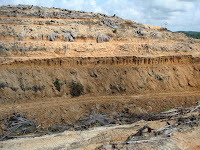
On INLAND or undulating area, planting pattern and terracing needs are usually determined by the degree of slope present. Slope assessments should be made before any terracing and lining work is considered. To facilitate mechanization and to improve soil or water conservation mechanical terrace-paths, sometimes are constructed in between palm rows along the contour.
i) Conservation Terraces
Normally these are constructed in terrain between 5-10` gradient. Each terrace is spaced every 30m apart and about 3m wide. The cut is deeper at about 20` gradient to check erosion as well as to conserve water. Stop bunds of about 1m wide are constructed every 30m apart along the terraces to prevent lateral erosion. We had tried recently constructed these bunds from uncut soil as they are not washed away. The straight line planting system is used in areas with these terraces.
ii) Double Terraces
These are terraces constructed in two tiers in areas between 10-20` gradient. The top terrace is the planting row while the bottom terrace is for the movement of vehicles. Double terracing allows mechanization and this concept has not been widely practiced but with more emphasis on mechanization, we do hope it will gain acceptance in the very near future. The total width is the same as that of any single terrace. Besides allowing mechanization of operations even in the early stage, this technique is excellent for erosion control in that there are two tiers of terraces, to check the flow of water.
iii) Single Terraces
These are the traditional terraces of various widths ranging from 3.5m to 4.5m and are constructed in terrain of more than 20` gradient. Terrace width must cater for mechanization.
The Mechanical terracing is an expensive but it has numerous of advantages to our development:-
1) Conserve soil
2) Conserve water
3) Prevent or reduces fertilizer wash
4) Easier accessibility for field operations.
5) Improves crops recovery or productivity
6) Protect roads
7) Facilitates
f) Construction of chamber/platforms
Construction of a chamber/platform at the planting row with a compacted height of 30-45cm may be required in areas where the water table is high (areas to be confirmed by the manager).
g) Drains construction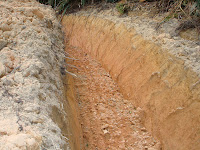
The best time to resolve any drainage problem is at the time of land preparation. An excavator is normally used to construct the drains. On wide ravines, the system of foothill drains regularly channeling water into one or more main drains has been found to be superior to other system such as ‘herring bone’ drainage pattern.
For the foothill drain, it must be correctly located at the foothill and the not near foothill to be fully effective. A depth of 60 – 90 cm is normally sufficient but the widht has to take into account the water flow down the hills. Narrow ravines can be drained easily with a central main drain but occasionally scupper drains lead to water from localized low spots are required.
An important aspect of drain construction is that the density and size of drains are dependent on the volume of water to be removed, soil type and depth of water-table. The type and size to be considered are as the following:-
i) General cross sectioned dimensions of main, collection and subsidiary drains are as follow:-
Type
|
Top Width (cm)
|
Bottom Width (cm)
|
Depth (cm)
|
Main
|
300
|
100
|
200
|
Collection
|
200
|
60
|
100
|
Subsidiary
|
100
|
30
|
75
|
ii) For coastal and acid sulphate soil, the drain dimension are as follow:-
Type
|
Top Width (cm)
|
Bottom Width (cm)
|
Depth (cm)
|
Main
|
240
|
120
|
180
|
Collection
|
180
|
60
|
135
|
Subsidiary
|
105
|
45
|
60
|
iii) For peat area, the drain dimension are as follow:-
Type
|
Top Width (cm)
|
Bottom Width (cm)
|
Depth (cm)
|
Main
|
240
|
120
|
180
|
Collection
|
180
|
60
|
135
|
Subsidiary
|
90
|
45
|
60
|
* The subsidiary drains standard practice is 1 drain to every 4 rows of oil palms.
h) Soil & Water Conservation
It is an important role in oil palm establishment and growth especially in areas receiving high rainfall, or poor soil structure and texture and hilly areas. The factors that can be implemented are as follow:-
i. Terrain condition – flat, undulating and hilly.
ii. Rainfall – total and distribution of rainfall.
iii. Soil type – structure, texture and etc.
i) Lining
Lining is usually commence soon after completion of land preparation or 1 – 2 months prior to seedlings being planted in the plantation. The main objective of lining is to determine the planting point of seedling and the other objectives are to provide an evenly spaced of palms, to give each palm has the same access to nutrients, water and sunlight and to achieve optimum stand per hectare, the systematic irrigation and harvesting, efficient transportation and to ensuring high yield in the future. The equipment and material should be use or prepare in lining are prismatic compass, 100m tape, wire cable marked with suitably bullets, lining pegs (painted red or white) of 1.2 meter height. Must provided a lining gang consists of about 6 people that has been trained and equipped. The general considerations for lining that we have to remember is an alignment. It should be in a general North-South direction. This will enable optimization of sunlight. An alignment should be parallel to irrigation canal and perpendicular to roads. The straight lining is usually use in flat area. The exact direction and location of the planting rows should be determined during the pre-lining exercise. The pattern of lining should be in tringular. The relation between the planting rows and the planting points distances varies according to the stand per hectare required as shown in the table below:-
Distance between planting rows (m)
|
Distance between planting points (m)
|
Stand per Hectare
|
7.32
|
8.53
|
160
|
7.62
|
8.84
|
148
|
7.92
|
9.14
|
136
|
The terrace lining also can use the Violle Lining System. In this system, the distance between are adjusted to obtain the required SPH. When two terrace are far apart, the distances between palms on the terrace are closer and vice versa. Lining stakes to be feet high and coloured to enable for distant viewing.
j) Holing
Planting hole to be dug mechanically where possible post-hole digger or by manually. Planting holes of 60 cm x 60 cm x 60 cm dimension should be dug with a 46 cm Auger. Holes should be dug in 15 cm deeper than height of the polybag so as to assist initial root penetration.
k) Transportation and Distribution of seedlings
Palms should be ‘rocked’ at least 2-4 weeks before planting. During loading and trasporting the seedling, it must be handled carefully. The loader must holding to the polybag or the seedling base to prevent damages to its leaf or shoot. Unloading and distributed close to the planting holes. The supervisor must record the number of seedlings taken out from the nursery and must received in the field at the same quantity. The supervisor also must record all the rejected or culled and planted of the seedling in the field for every day.
Planting is carried out within 2 months after felling and shredding. Oil palm seedlings should be planted immediately after the lining and holing had been done. Before planting the oil palm seedling, an each of planting hole must be applied with 500 g of Rock Phosphate. Slit the bottom of the polybag using a sharp knife or blade. The seedling must placed into the planting hole by carefully, put it in stable or hefty. Partially, fill the hole with soil and compact it.
m) Legume cover crop (LCC)
In oil palm plantation, the establishment of legume cover crop gave a significant and economically higher yield compared to palms with natural covers. The four type of legume cover crop are Calapogonium Mucunoides (CM), Pueraria Javanica (PJ), Calapogonium Caeruleum (CC) and Mucuna Bracteata (MB).
The benefit of planting legume cover crop are:-
i. To improve soil structure and texture
ii. To minimize soil erosion
iii. To prevent growth of noxious weeds
iv. To reduce breding site
v. To improve soil fertility through decomposition of organic matter, recycling of soil nutrient and nitrogen fixation.
The recommended LCC seedling mixture planted rates per hectare are as follow:-
a) Pueraria Javanica (PJ) Mix Calapogonium Caeruleum (CC)
LCC Type
|
Flat/Undulating Area
|
Terrace Area
|
PJ
|
4 kg/ha
|
3 kg/ha
|
CC
|
2 kg/ha
|
1.5 kg/ha
|
ii) Pueraria Javanica (PJ) Mix Mucuna Bracteata (MB).
LCC Type
|
Flat/Undulating Area
|
Terrace Area
|
PJ
|
6 kg/ha
|
4 kg/ha
|
MB
|
1 plant/palm
|
1 palnt/palm
|
Mulching of palms with empty fruit bunch (EFB) is after planting. Mulch around the palm base with up to 2 rings of EFB at around 25 bunches. The advantages of mulching EFB are:-
i. Increasing vegetative vigor and subsequent yield through expected improvement in soil physico-chemical properties
ii. Soil moisture regime
iii. Root growth and a concomitant reduction in surface wash
iv. Leaching and soil surface temperature contributed to creating a conductive environment for good palm establishment
The aim of good development of land preparation on replanting, all the key practices should be followed to ensure high management efficiency comply with environmental legislation and best growth and productivity of new generation of palms. The expenditure cost in this replanting proses are very high but the return in the future is surely high due to high yield and good guality of FFB.
5. REFERENCES
i. Sime Darby Plantation Sdn Bhd, Ladang Salak,PD
ii. Management and staff/ workers NSOP, Ladang Ibam
iii. Chin Teck Plantation Sdn Bhd, Gemima Estate


 Sebelum pembinaan jambatan baru...ianya di buat kebanyakkannya mengunakan kayu...tetapi, jambatan tersebut telah musnah di bahamsungai yang amat deras...setelah hujan kuat...biasa lah kat gua musang ni, memang mempunyai kadar hujan yang tinggi...sukar lah kalau kerja di perladangan ni...kalau dah hari-hari hujan, macam-macam yang perlu di hadapi, keadaan jalan yang selalu rosak, bukit selalu runtuh, banjir, macam-macam hal lah...pahtu, HQ plak selalu datang, diorang cakap kitaorang tak buat kerja lah apa lah...ini lah dugaan nye....
 Permulaan pembinaan, rangka tiang atau tapak dibina terlebih dahulu bagi menggantikan tiang yang telah rosak. Tiang tersebut perlu dibina atau dibuat dengan lebih teliti supaya ianya kukuh dan kuat. Ini adalah kerana, keadaan arus sungai di ladang gua musang ini adalah deras. Dan ianya akan lebih deras lagi sekiranya hujan tiba. Arus air sungai ini boleh mencecah pada kelajuan 60-100 km sejam apabila hujan lebat di hulu sungai. Selain itu, tiang tersebut mesti lah kuat menahan sebarang hentakan dan tekanan daripada kenderaan mahupun sampah sarap serta kayu balak yang dibawa oleh arus air tersebut.
 Setelah tiang selasai dibina dan di concrete kan, pemasangan rangka bagi jambatan dilakukan, semua kerja-kerja tersebut telah dilakukan oleh pekerja estet ini sendiri. Kerja-kerja pemasangan rangka yang memerlukan banyak besi dan perlu di welding secara keseluruhannya. kebanyakannya mengunakan tenaga foreman yang kami ada. seperti di gambar, kami sedang memasang plate bagi menahan concrete simen yang akan diletakkan setelah selesai kerja-kerja pemasangan rangka besi tersebut.


